Showing posts with label review. Show all posts

Monday, August 22, 2011

Review: Juliet by Anne Fortier

When Julie Jacobs inherits a key to a safety-deposit box in Siena, Italy, she is told it will lead her to an old family treasure. Soon she is launched on a winding and perilous journey into the history of her ancestor Giulietta, whose legendary love for a young man named Romeo rocked the foundations of medieval Siena. As Julie crosses paths with the descendants of the families involved in Shakespeare’s unforgettable blood feud, she begins to realize that the notorious curse—“A plague on both your houses!”—is still at work, and that she is the next target. It seems that the only one who can save Julie from her fate is Romeo—but where is he? (summary from cover).


I read a lot of favorable reviews of Juliet when it came out last year, but just got around to reading it. It was the perfect book for traveling--let's just say I didn't want the plane flight to end! I felt like I was on the hunt with Julie as she uncovered clues about her true identity and tried to unravel the tangled legacy of her family and their relationship to an ancient curse.

The format of alternating between the present day and the events of 1340 that led to Shakespeare's famous play kept my interest, and I loved that the characters were all three-dimensional and complex. Both the hero and heroine have things in their past they'd rather not share, and other characters blur the line between good and evil. The relationship between Julie and her twin sister Janice was especially well-written, as they move from being bitter childhood rivals to working together and finally understanding each other better.

Beautiful Siena
Fortier's writing evoked the lush countryside around Siena and made me want to hop on a plan to Italy immediately. The mix of superstition and family loyalty in the Sienese was really interesting, as was the importance of the Palio, a horse race that still takes place today. I wish the author had explained some of the Italian architectural terms she used (like loggia) as I sometimes had trouble visualizing where the scene was taking place, but that was a minor issue with an otherwise engaging book.

Romeo, Romeo, wherefore art thou Romeo?
Rating: 4.75 out of 5 stars. This is a wonderful book for these last remaining weeks of summer or any time you want to escape into a different place and time. If you love history, mystery or romance (or all three) I would recommend reading Juliet.

Details: 480 pages, published by Ballantine, July 2011
Source: personal copy

Monday, August 15, 2011

Faith and Fiction Roundtable: Small Town Sinners by Melissa Walker

Lacey Anne Byer is a perennial good girl and lifelong member of the House of Enlightenment, the Evangelical church in her small town. With her driver's license in hand and the chance to try out for a lead role in Hell House, her church's annual haunted house of sin, Lacey's junior year is looking promising. But when a cute new stranger comes to town, something begins to stir inside her. Ty Davis doesn't know the sweet, shy Lacey Anne Byer everyone else does. With Ty, Lacey could reinvent herself. As her feelings for Ty make Lacey test her boundaries, events surrounding Hell House make her question her religion (summary from cover).


The Faith and Fiction Roundtable hosted by My Friend Amy recently read and discussed the YA novel Small Town Sinners by Melissa Walker, which focused on perennial good girl Lacey's coming-of-age during her church's annual production of a Hell House. I had a hard time relating to Lacey as a character, and her voice never really rang true for me. I also found the characters a little flat and one-dimensional, especially the adults like Lacey's father, the church's children's pastor. However, I appreciated that Walker left Lacey's spiritual journey open-ended at the conclusion of the book. Faith is such a complicated and personal thing, and I think we'll never have all the answers or our doubts fully resolved this side of heaven. This questioning made Small Town Sinners seem much more authentic.


Faith and Fiction

I personally have never been to a Hell House, but I remember being absolutely terrified after hearing about one my friends went to when we were in middle school (one room involved a young girl screaming for her mother and being told she'd never see her again or something to that effect). I appreciated that this book brought up the subject, because I think hell is a topic that many people have differing opinions about and often find hard to comprehend, myself included. Rob Bell's recent book Love Wins caused a stir when it was released because of his interpretation that Hell is caused by bad choices and that God sentencing someone to Hell for rejecting Him goes against His loving nature. I've found a lot of comfort reading the writings of C.S. Lewis and Dr. Tim Keller on the subject, and of course the Bible. The idea of a Hell House being such a big part of a church's outreach and mission was definitely interesting to think about, whatever flaws I may have found with the writing and characters.

Check out some of the other Roundtable members' thoughts: Heather, Amy, Ronnica, Carrie K, WordLily,
Julie

Source: I received a free copy of this book in exchange for my honest review.

Monday, June 27, 2011

Review: The Gardner Heist by Ulrich Boser

Shortly after midnight on March 18, 1990, two men broke into the Isabella Stewart Gardner Museum in Boston and committed the largest art heist in history. They stole a dozen masterpieces, including one Vermeer, three Rembrandts, and five Degas. But after thousands of leads—and a $5 million reward—none of the paintings have been recovered. 

After the death of famed art detective Harold Smith, reporter Ulrich Boser decided to take up the case. Exploring Smith's unfinished leads, Boser travels deep into the art underworld and comes across a remarkable cast of characters, including a brilliant rock 'n' roll thief, a gangster who professes his innocence in rhyming verse, and the enigmatic late Boston heiress Isabella Stewart Gardner herself (summary from Goodreads).


One of my reading resolutions for 2011 was to read more non-fiction, a genre I normally don't give as much attention to since I find a lot of the books very dry. However, I love a good mystery (especially one involving art theft- it must be due to my early watching of How to Steal A Million with Audrey Hepburn) and it's amazing that after 21 years this case is still unsolved. And with last week's capture of mobster James "Whitey" Bulger, who was suspected of being involved in the theft, this case has been back in the headlines recently. It's always cool when real life intersects with what you're reading at the moment!
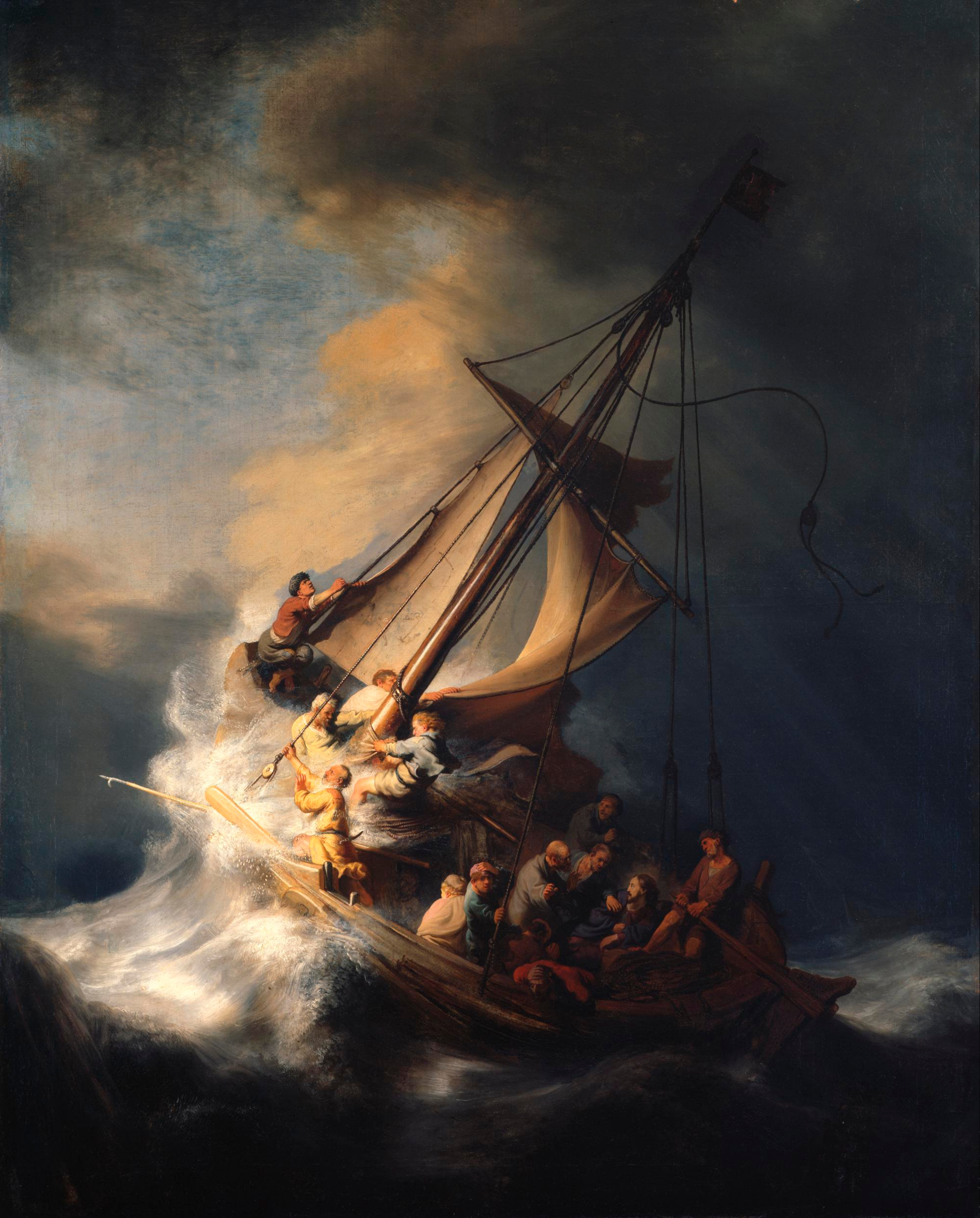
The Storm on the Sea of Galilee, Rembrandt
The Gardner Heist introduces a wide range of potential suspects and investigators, from prolific thief Myles Conner and his lawyer Marty Leppo to the Cockney nicknamed "Turbo" who aids in the investigation. Though I occasionally lost track of who was who (especially the law enforcement officers) I enjoyed the way the book was organized, with chapters focusing on certain people and their role in the case and then tying them back into the bigger picture of the theft. It heightened the suspense and helped keep the story moving.

Boser occasionally adopts a grandiose tone with regards to the theft and the importance of the art, and his descriptions sometimes verge on the overly dramatic (one character eats ribs "gnawing each bone as clean as a sun-bleached skeleton"). However, I wasn't at all familiar with the case or the missing paintings before I read The Gardner Heist, but by the end I found myself feeling the loss of the artwork and wishing I could see The Storm on the Sea of Galilee or Vermeer's The Concert in person. 

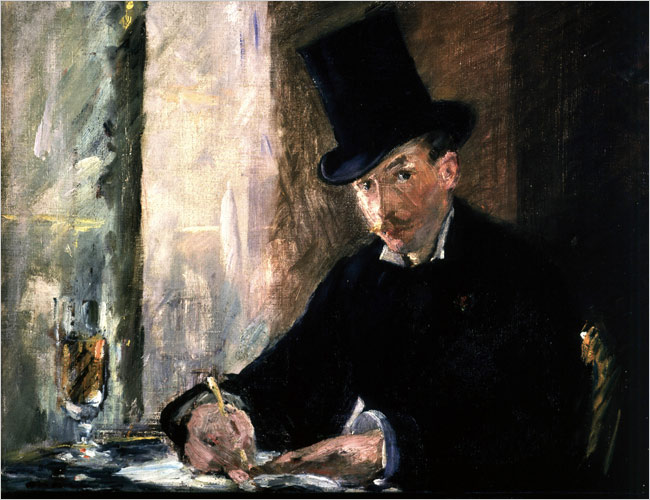
Chez Tortoni, Manet
Rating: 4 out of 5 stars. The Gardner Heist is a readable and interesting account of the theft and the following investigation that offer several compelling theories on who might have taken the priceless paintings. Boser still maintains a website where people can submit tips and find out more information about the case: http://theopencase.com/gardner.

Details: published by HarperCollins, 2009
Source: library copy

Sunday, May 1, 2011

Review: The Violets of March by Sarah Jio


In her twenties, Emily Wilson was on top of the world: she had a bestselling novel, a husband plucked from the pages of GQ, and a one-way ticket to happily ever after. Ten years later, the tide has turned on Emily's good fortune. So when her great-aunt Bee invites her to spend the month of March on Bainbridge Island in Washington State, Emily accepts, longing to be healed by the sea. Researching her next book, Emily discovers a red velvet diary, dated 1943, whose contents reveal startling connections to her own life (summary from back cover).


About Sarah Jio:
Sarah is a veteran magazine writer and the health and fitness blogger for Glamour magazine, a role she’s had for nearly three years. In addition, she is a women’s health contributor to Womansday.comthe web site of Woman’s Day magazine. She has written hundreds of articles for national magazines and top newspapers including Redbook, O, The Oprah Magazine, Cooking Light, Glamour, SELF, Real Simple, Fitness, Marie Claire, Hallmark magazine, Seventeen, The Nest, Health, Bon Appetit, Gourmet, The Seattle Times, Parents, Parenting, and Kiwi. In addition, Sarah is a monthly columnist for American Baby. She has also appeared as a commentator on NPR’s Morning Edition.

If you've been reading this blog for any length of time you can probably tell that I'm obsessed with anything set in the WWII era, so I was excited when I was asked to review Sarah Jio's The Violets of March. The book features a mysterious diary written in 1943, and though WWII ended up playing only a minor role in the story, I enjoyed this wonderful novel nonetheless.  

It took me about 50 pages to really get into the story, due mostly to the occasionally awkward writing and metaphors ("' We almost didn't make it home that night,' he said, his eyes like portals into the forgotten memories of my youth.") However, I was soon caught up in the developing love story and the mysteries surrounding the diary that Emily finds. I found Emily to be a admirable character, who learns from her mistakes and has the clarity to listen to the voice inside her. Though she has the tendency to jump to conclusions easily (like the author of the mysterious diary) she also knows herself.

I also enjoyed the gently suspenseful tone of the book and the mystery surrounding the diary. When I thought I had figured out how the pieces all fit together, something happened to change my mind. The ending was thoughtful and bittersweet and I enjoyed seeing all of the loose ends tied up neatly, but not too predictably. 

Rating: 4 out of 5 stars. While it sometimes got bogged down by clunky writing, The Violets of March was a lovely book with a mix of mystery, romance, and likeable characters. I look forward to reading the author's next book, The Bungalow (to be released in spring 2013).

Details: published by Plume, April 2011 

Source: Thanks to Sarah Jio and Plume for providing me with a copy of this book in exchange for my honest review.

Tuesday, April 12, 2011

Review: Surrender the Heart by MaryLu Tyndall

Relive the rich history of the War of 1812 through the eyes of Marianne Denton and Noah Brenin, who both long to please their families but neither one wishes to marry the other. Noah is determined to get his cargo to England before war breaks out, and Marianne is equally determined to have a wedding so that her inheritance can be unlocked and her destitute family saved. When their stubborn games get them captured by a British warship, can they escape and bring liberty to their country--and growing love? (summary from marylutyndall.com)


This probably wasn't the best book to read while touring France, since I found myself eagerly wanting to get back to the hotel so I could read more of Marianne and Noah's story. It's that good!

I loved the character of Marianne and found myself relating to so many of her struggles and insecurities. She thinks of herself as no great beauty, and after experiencing personal tragedy and hardship has resigned herself to expecting nothing more than an ordinary life. When circumstances land her on her reluctant fiance's merchant ship sailing to England, she has to face her past and the issues that have haunted her. There were a few times where I was frustrated by her lack of trust, but that really showed the power anxiety can have over us. When she finally trusts God enough to face her fears and fulfill her destiny it is a really nice moment.

Though Noah starts out as a somewhat unlikeable character (at least in terms of his treatment of Marianne) he becomes an admirable hero. He is burdened by guilt over his brother's death and his family's expectations but possesses a strength of character and a willingness to stand up for what is right. I loved that Noah slowly comes to admire Marianne's courage and kindness and realizes just how beautiful she really is. I'm always a sucker for the "dislike turning into attraction" storyline (aka Elizabeth Bennett and Mr. Darcy), and Surrender the Heart delivered that in spades.

In terms of the historical backdrop, I really enjoyed Tyndall setting the book in the months leading up to the War of 1812. That war often seems like just a blip on the history of the U.S., but she shows how critical a victory was to our very young nation and how unmatched we seemed to be against the British. It made me want to read more about the contest and America during that time.

A few minor issues with the story... for the most part, I thought that the character's journeys toward faith were realistic and heartfelt, but there were a few instances where everything seemed to fall into place too quickly. It was like one minute a character was burdened by guilt and the next they were suddenly free. I know that God is capable of radically changing people's hearts, but it seemed a little fast. Also, I hated how Noah occasionally referred to Marianne as "princess." Maybe it's just a weird quirk of mine but I squirmed every time he called her by that name (which luckily was only three or four instances in the book.)
 
Rating: 4.5 out of 5 stars. This book kept me totally riveted with its mix of romance and adventure set against the first months of the War of 1812. The characters were likable and relatable and I was caught up in their love story.

Details: published by Barbour, August 2010. Book 1 in the Surrender to Destiny series.
Source: personal copy

Monday, March 14, 2011

Review: Jane Eyre (2011)

When the credits rolled at the end of a sold-out showing of Jane Eyre this past weekend, my friend and I turned to each other and said "huh." I think we were both torn between loving the movie and feeling vaguely let down by it. First and foremost, Mia Wasikowska is fantastic as Jane. I've seen 2 other adaptions (the 2006 version with Ruth Wilson and the 1943 version with Joan Fontaine), and Wasikowska's portrayal is by far my favorite. She perfectly embodies the strong will and spirit that hides beneath the plain (OK, plain for an actress in a big budget movie) exterior. The exchange between Jane and Rochester when he calls her into the drawing room on his return to Thornfield ("do you think me handsome?" "no, sir.") crackles with energy and you can see his regard for her growing as she speaks with him.


I also found Michael Fassbender's Rochester to be wonderfully complex. Yes, he is enigmatic and often harsh (I've never liked in the book and movie how he openly dislikes Adele), but there is a tenderness here that makes him more human than other versions of the character. When Bertha flies at him he restrains her almost compassionately, and it is a testament to Fassbender's acting that he conveys how Rochester despises Bertha and his awful mistake in marrying her but cannot act cruelly towards her. In the scene where Rochester tries to convince Jane to stay with him after their failed wedding you can sense his anguish and the almost herculean strength she needs to overcome his offer.


The cinematography work by Adriano Goldman is stunning. Thornfield Hall comes alive, both in the dreariness of winter and the lightness of spring and summer, and I really got a feel of what it might be like to live a monotonous life in an isolated mansion with only an older woman and child for company. This version definitely amps up the gothic elements and the creepiness of the house and is well-served by strong supporting characters (Jamie Bell as St. John Rivers and the fabulous Judi Dench as Mrs. Fairfax are the two obvious standouts, but Sally Hawkins is also wonderfully icy as Mrs. Reed).


So why didn't I absolutely love it? Obviously, trying to condense a 500-page book into 115 minutes on screen means that certain parts of the story will be edited out, but I was puzzled by the scenes that were omitted. The most glaring one was leaving out that Jane and the Rivers siblings are cousins. Instead, Jane gives away 3/4 of her inheritance due to their kindness in taking her in (at least that's what I assumed, as it never was really explained). Also, while there is a tender scene with Jane returning to the remains of Thornfield and the now-blinded Rochester, there is no epilogue to show that they married and he eventually regained sight in one eye. I think if I hadn't read and enjoyed the book so much, I would have absolutely adored this movie. As such I enjoyed it immensely but felt it couldn't measure up to the powerful and affecting emotion of Bronte's original story.

Thursday, January 20, 2011

Review: Zan-Gah and Zan-Gah and the Beautiful Country by Allan Richard Shickman

Zan-Gah, seeking his lost twin brother in a savage prehistoric world, encounters adventure, suffering, conflict, captivity, and final victory. In three years hero passes from an uncertain boyhood to a tried and proven manhood and a position of leadership among his people. The prehistoric saga continues in Zan-Gah and the Beautiful Country... in this story, Zan's troubled twin brother, Dael, having suffered greatly during his earlier captivity, receives a ruinous new shock when his wife suddenly dies. His obsession is the destruction of the wasp men, his first captors, who dwell in the Beautiful Country. When he, Zan-Gah, and a band of adventurers trek to their bountiful home, they find that all of the wasp people have died in war or of disease. The Beautiful Country is empty for the taking, and Zan's people, the Ba-Coro, decide to migrate and resettle there. (summaries from goodreads)


I liked that Shickman's writing was intelligent and not dumbed down or gimmicky like a lot of current YA novels seem to be. Instead it uses a mix of action and multi-dimensional characters to pull the reader in. When Zan and the other members of the tribe are preparing to trap a lioness in the first novel, you can feel the ratcheting up of tension as the drums beat and the animal circles the ring of people. In Zan-Gah and the Beautiful Country, Shickman makes you feel Dael's anguish and the pitch of battle as they fight the Noi warriors. However, sometimes I found the writing awkward, like when he describes the living conditions of the prehistoric humans in the first book:  "Darkness was indeed darker to them then, coldness colder, and the cruelest passions somehow crueler and more deeply passionate." This wordiness sometimes worked against the narrative pull of the story.


As a character, Zan is extremely honorable and heroic and always tries to do the right thing. Boys will enjoy how independent he is and how he manages to take care of himself and his friends, and will dream about killing a lion single-handedly, catching fish with their bare hands or fighting off enemies with a weapon of their own imagining. Zan also is able to deal with serious issues with a wisdom beyond his years, like a brother deeply scarred by the loss of his wife and many years in captivity. I thought it was fascinating to have one of the characters struggling with what would now be diagnosed as PTSD. Dael's trauma added a deeper level to the story than just Zan fighting off animals and competing tribes.

Author Allan Richard Shickman
Rating: Zan-Gah and Zan-Gah and the Beautiful Country: 4 out of 5 stars for both. I would recommend these books to anyone who is looking for intelligent and exciting YA novels for a 10-15 year old boy. The violence is not gratuitous and the action will keep them reading past their bedtime, and it tackles issues like trauma and loss in a thoughtful and age-appropriate way.
Source: I received these novels from Earthshaker Books in exchange for my honest review.

Tuesday, January 18, 2011

Review: Framed

I finally got around to watching Framed, one of the Masterpiece Contemporary offerings from the 2010 season, and it is a delight!

Quentin (Trevor Eve) and Angharad ( Eve Myles)
When flooding in London's National Gallery precipitates the transfer of its treasured paintings to safety in an abandoned slate mine in the Welsh countryside, curator Quentin Lester (Trevor Eve), a worshipper of art to the exclusion of people, squires his beloved masterpieces to safety, secretly pleased to have them all to himself. There, he encounters a lineup of quirky inhabitants including the spirited and lovely, if slightly nosy, local schoolteacher, Angharad (Eve Myles), and a 10-year-old boy, Dylan Hughes. In a chain of misunderstandings triggered by a wayward chicken, Quentin mistakes Dylan, whose father has just left the family in the face of financial woes, for an art connoisseur and kindred spirit. But when Dylan, in desperation, plans the art heist of the century with his criminal-mastermind-in-training sister Minnie, the results reveal how these paintings on the move have tremendous power to move people. Framed is based on the bestselling book by Frank Cottrell Boyce (summary from PBS).
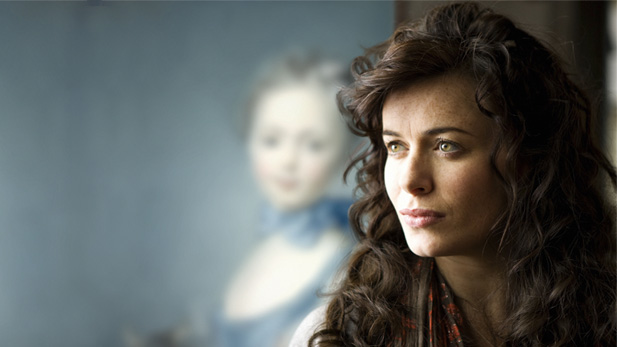
Angharad
Framed is an uplifting story that centers around the small Welsh village of Manod, which secretly sheltered National Gallery paintings during WWII and is called into service again after a flooding at the museum. Quentin Lester arrives from London hoping for a solitary existence with only the paintings for company, but is soon charmed by the local teacher Angharad and the collection of unique locals. There is a nice symmetry between Angharad's high-spirited ways and Quentin's more guarded and cynical persona. She helps him to see that art is not meant to be kept in safe and secure boxes for viewing by a select few, but should be shared and experienced by all. He in turn shows a surprising depth and unexpected kindness towards the townspeople. The scene where Angharad explains to Quentin that Dylan's love of Donatello has more to do with the Teenage Mutant Ninja Turtles than Italian Renaissance painters is so charming and funny. And it's inspiring to see each character make their own art out of the difficult circumstances in their lives, whether it's Marie creating a photo collage of her baby brother or the butcher finding solace and purpose through a Monet painting.

Dylan and Minnie Hughes (Samuel Davies and Mari Ann Bull)
I thought the young actors playing Dylan and Minnie (Samuel Davies and Mari Ann Bull) were fantastic, and able to demonstrate a wide range of emotions, from despair at their father leaving to Minnie's craftiness in hatching a plan to save their struggling garage. Using a knowledge of crime taken exclusively from the movie The Italian Job, she decides to steal a painting from the cave and use it to raise money. Her older brother is just along for the ride until she reveals that her plan didn't extend past the actual theft. Luckily everything works out in the end, for the townspeople, Quentin and Angharad and the Hughes family.

Rating: 4 out of 5 stars. Lively, funny and sweet, Framed is an enjoyable story about the power of art to transform a village and the people in it. I only wish it had a longer running time than 82 minutes so the writers could have devoted more time to each character's story, especially the romance between Quentin and Angharad. Framed is available to watch online here until January 25.

Tuesday, January 11, 2011

Review: The Sissi Trilogy


I recently came across a 1955-57 period drama trilogy that is available to watch instantly on Netflix, called Sissi, Sissi: The Young Empress and Sissi: Fateful Years of the Empress. I'm a sucker for anything historical and the synopsis and cover looked really interesting, so I decided to give the first one a try. Though the tag Foreign should have given it away, I was surprised to realize that the movie was in German (thank goodness English subtitles are included!) However, I was quickly sucked into this very loose retelling of the life of Elisabeth of Bavaria-- called Sissi by family and friends-- who would become Empress of Austria and Queen of Hungary in the late 19th century.


In the first movie, we meet Sissi and her family, including her friendly and slightly roguish father Duke Maximilian and her lovable and harried mother Princess Ludovika. Sissi accompanies her mother and older sister Helene, called Nene, to Vienna, where she has a chance meeting with her cousin Franz Josef, the Emperor of Austria. Franz is instantly smitten, not realizing that his domineering mother, the Archduchess Sophie, has already arranged for him to marry Nene. Though Sissi is reluctant to take on the demanding role of empress, she loves Franz and he persuades her that he would be unable to rule without her. The movie ends with their wedding (after Franz basically announces their engagement without her consent) and Sissi becoming Empress of Austria.

Franz and Sissi meet cute on an Austrian mountain
Franz giving roses to Sissi instead of Nene (left)
In the second film, Sissi: The Young Empress, Sissi is homesick for Bavaria and without her husband most of the day due to his state duties. She also is faced with learning the extremely rigid and convoluted court etiquette and the languages of all of Austria's principalities. Her free-spirited ways clash with her aunt/mother-in-law who rules with an iron fist, and her husband is mostly content to follow his mother's orders.When the couple's first child is born and the Archduchess takes over the raising of the child without Sissi's consent, she flees the palace, but is reunited with Franz later after he realizes he's mistaken and comes after her. Her dedication to and support of the Hungarian people leads to the emperor and empress being crowned King and Queen of Hungary at the end of the film.


The Emperor, Empress and Archduchess
The final installment begins with Sissi and her daughter in Hungary, trying to broker peace between Austria and a few remaining Hungarian rebels. When Count Andrassy, a young Hungarian nobleman who has become Sissi's friend and advisor, confesses he's in love with her, she realizes she must leave the country. Meanwhile, back in Vienna, Franz is fending off his mother's not-so-subtle hints that Sissi and Andrassy are having an affair and learning that Nene is still not over him two years after their broken engagement. Luckily Franz begins to grow a backbone in this film and challenge his mother's "duty over love" mentality. Franz and Sissi are reunited, but it soon becomes apparent she is not well, and she travels to Madeira as a last ditch effort to heal from a lung ailment. The movie ends with a dramatic and touching reunion between Sissi and daughter in Venice, where her love and goodness wins over the people of Italy.


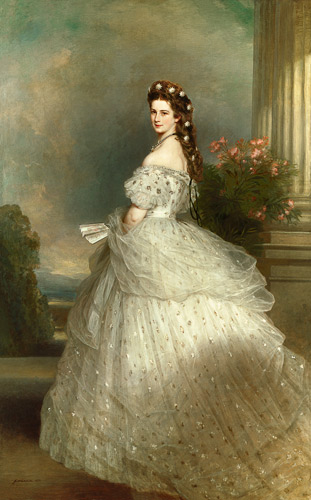
Portrait of the real life Sissi by Franz Xaver Winterhalter
If you have a few hours to kill on a rainy afternoon, I would suggest these films as a great option. Are they a little schmaltzy and overdramatic? Definitely. But they're also interesting--though not entirely factual-- period pieces that come complete with stunning images of the Austrian countryside, beautiful costumes and a lovable heroine. Romy Schneider is gorgeous as Sissi (I was extremely envious of her beautiful hair and tiny waistline) and Karlheinz Bohm is an appealing (if sometimes slightly wimpy) hero. The films also made me more interested in the real-life story of Elisabeth, which unfortunately did not end as happily as the film suggests. According to historical reports, the real Sissi had an unhappy and unfaithful marriage and kept herself on a strict diet to maintain a 20 inch waistline, and she also was assassinated by an anarchist in 1898. I think I prefer the movie ending better!

Source: Netflix instant streaming

Thursday, December 23, 2010

Review: The Betrayal of the Blood Lily by Lauren Willig

I just found a review I had written a few months ago of Lauren Willig's sixth installment in the Pink Carnation series, The Betrayal of the Blood Lily, which was released last January. If you haven't read the previous books you need to start with the first (The Secret History of the Pink Carnation), as Willig builds on the characters' relationships and the relationship between the modern day heroine Eloise and Colin Selwick. While I always love Willig's writing and have devoured the previous books, I must admit this is tied for my least favorite with The Seduction of the Crimson Rose.


Like Mary Alsworthy, Penelope Staines (nee' Devereaux) is a difficult heroine, and though you come to admire her strength and wit as love softens her, she is not easy to love. Also, (BIG SPOILER ALERT) I was really bothered by the adultery that took place between the still-married Penelope and Captain Alex Reid. In her previous books Willig has pretty much confined the sex scenes to when the characters were (however reluctantly) married, so I came into Blood Lily expecting the same. I know it contributed to the image of Penelope as more of a rebel, but it cheapened their relationship to me. On the positive side, Willig's writing is as witty and fun as ever, and it was nice to see a feisty woman match wits with a handsome, kind and honorable hero. Willig's descriptions of India are very evocative and obviously very well-researched.

Rating: 3.5 out of 5 stars. Wanted to love it, just couldn't really identify with Penelope as I had with previous heroines Henrietta, Letty and Charlotte. However, I did enjoy it and loved The Mischief of the Mistletoe (see review here), so I'm looking forward to reading Willig's next book, The Orchid Affair..

source: personal copy

Saturday, December 18, 2010

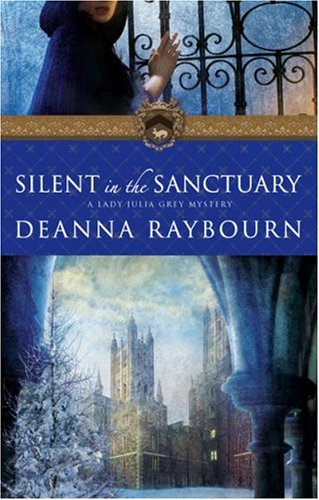
Review: Silent in the Sanctuary by Deanna Raybourn

Fresh from a six-month sojourn in Italy, Lady Julia returns home to Sussex to find her father's estate crowded with family and friends— but dark deeds are afoot at the deconsecrated abbey, and a murderer roams the ancient cloisters. Certain of her cousin's innocence, Lady Julia resumes her unlikely and deliciously intriguing partnership with Nicholas Brisbane, setting out to unravel a tangle of deceit before the killer can strike again. When a sudden snowstorm blankets the abbey like a shroud, it falls to Lady Julia and Nicholas Brisbane to answer the shriek of murder most foul (summary from goodreads).


 The second installment in Deanna Raybourn's Lady Julia Grey mystery series was even better than the first, Silent in the Grave. I was eager to see more of Julia and Nicholas Brisbane's passionate but unsettled romance and enjoyed Julia's witty narrative voice and the coloful cast of secondary characters. Similar to the first book, the murderer was unmasked and the mystery solved by the last pages, but not fully. Like real life, there is never a perfect ending or justice entirely served, and the loose ends and unanswered questions made the story more realistic. I felt like the characters were fully formed and multi-dimensional, with their own quirks and unique qualities that made them seem like flesh-and-blood people.

Rating: 4.5 out of 5 stars. This book held my attention with the descriptive writing and mix of Victorian mystery, humor, and romance. I've already started the third book in the series, Silent on the Moor.

Source: personal copy

Wednesday, December 8, 2010

Review: The Unfinished Gift by Dan Walsh

Ian Collins is an old man without his son. Patrick Collins is a young boy without his father. On his Christmas list are only three items. He wants the army to find his father. He wants to leave his grandfather's house. And he wants the dusty wooden soldier in Grandfather's attic--the one he is forbidden to touch.
Set in December of 1943, The Unfinished Gift is the engaging story of a family in need of forgiveness. With simple grace, it reminds us of the small things that affect powerful change in our hearts--a young boy's prayers, a shoe box of love letters, and even a half-carved soldier, long forgotten (summary from cover).


The writing and dialogue is a little choppy, and sometimes I felt like the story was developing at the speed of molasses. But once I become invested in the characters, especially the adorable 8-year-old Patrick, I found I really enjoyed The Unfinished Gift. My heart broke for Patrick as he was confronted with the death of his mother, his grandfather Ian's coldness and his father's absence at Christmastime. Like Katharine Townsend, the young social worker assigned to Patrick's case, I wanted to shake his grandfather and make him see what a special kid Patrick was. But as a stack of letters and an old wooden soldier slowly bring a change to Ian's heart, we see the loneliness and pain behind his cranky facade begin to lessen.

Each character in the book is marked by the loss of a family member, be it mother, wife, or son, but God is still able to bring about healing and reconciliation. This was a message that really resonated with me and made the story more moving. I wish the ending had been a little less simplistic, and some of the characters more fully formed, but I enjoyed reading this and am looking forward to starting the sequel, The Homecoming. I can't say I was moved to tears like the book jacket promised, but it did get me into the Christmas spirit.

Review: 3.5 out of 5 stars. If you're in the mood to curl up with a simply written and uplifting Christmas novel, this is the book for you. It's not flashy or action-packed but it is a sweet story about second chances.

This book was one of my selections for All About {n}'s Holiday Reading Challenge.
 
Source: personal copy

Monday, November 29, 2010

Review: The Mischief of the Mistletoe by Lauren Willig

Reginald “Turnip” Fitzhugh—often mistaken for the elusive spy known as the Pink Carnation—has blundered into danger before. But when he blunders into Miss Arabella Dempsey, it never occurs to him that she might be trouble. When Turnip and Arabella stumble upon a beautifully wrapped Christmas pudding with a cryptic message written in French, “Meet me at Farley Castle”, the unlikely vehicle for intrigue launches the pair on a Yuletide adventure that ranges from the Austens’ modest drawing room to the awe-inspiring estate of the Dukes of Dovedale, where the Dowager Duchess is hosting the most anticipated event of the year: an elaborate 12-day Christmas celebration. Will they find poinsettias or peril, dancing or danger? And is it possible that the fate of the British Empire rests in Arabella and Turnip’s hands, in the form of a festive Christmas pudding? (summary from book cover)

The Mischief of the Mistletoe: A Pink Carnation Christmas
I have been a big fan of Lauren Willig's historical romance for a while and the release of The Mischief of the Mistletoe happened to fit in nicely with All About {n}'s Holiday Reading Challenge. While this can be read as a stand-alone Christmas novel, it's much more fun when you have read the previous entries in the Pink Carnation series (six in all, starting with the Secret History of the Pink Carnation). I loved seeing the reappearance of some of my favorite characters from earlier books, like Lord and Lady Pinchingdale and the fearsome Dowager Duchess of Dovedale.

I had never found Turnip Fitzhugh to be a particularly romantic character, but Willig creates a depth that makes him very appealing by the end of the story. As Arabella and Turnip romp through various adventures I was caught up in their story and the setting of Regency era Bath, England. I also enjoyed seeing an appearance by the famous Jane Austen (as an old family friend of Arabella's) and how Willig seemed to capture her smart and comedic take on society.

Rating 5 out of 5 stars. This book reaffirmed Willig's place on my list of favorite authors. Witty and fun, with plenty of chemistry between the two main characters, this was the perfect start to the holiday season! I would highly recommend this for Jane Austen fans or anyone who enjoys a blend of historical romance and comedy.
source: personal copy

Sunday, November 21, 2010

Review: The Healer's Apprentice by Melanie Dickerson

Rose has been appointed as a healer's apprentice at Hagenheim Castle, a rare opportunity for a woodcutter's daughter like her. While she often feels uneasy at the sight of blood, Rose is determined to prove herself capable. Failure will mean returning home to marry the aging bachelor her mother has chosen for her.When Lord Hamlin, the future duke, is injured, it is Rose who must tend to him. As she works to heal his wound, she begins to understand emotions she's never felt before and wonders if he feels the same. But falling in love is forbidden, as Lord Hamlin is betrothed to a mysterious young woman in hiding. As Rose's life spins toward confusion, she must take the first steps on a journey to discover her own destiny (summary from goodreads).


I had read lots of great reviews about this retelling of Sleeping Beauty and decided to check it out when it became available at the library. While The Healer's Apprentice is technically inspirational YA, that shouldn't deter adults from reading this updated fairy tale that comes complete with a handsome hero, evil villain and mysterious secret. Dickerson's writing transports you to medieval Saxony and I was soon completely involved in the story and the period details. Though I figured out the big secret by around Chapter 5, it was still very entertaining to read how the characters come to rely on God for assurance and direction on their way to a happy ending.

Rating: 3.5 out of 5 stars for adults, 5 out of 5 for YA. Though I found Rose to be a little too passive and Lord Hamlin a little too perfect, that didn't spoil my enjoyment of an otherwise wonderful and engaging tale. I would have raved about this book when I was 15 and as a twenty-something I still really enjoyed it.

Source: library copy.

Thursday, November 11, 2010

Review: Silent in the Grave by Deanna Raybourn

Chaos on the streets of Victorian London (from English Heritage)

Silent in the Grave tells the story of Lady Julia Grey, who is widowed when her husband Sir Edward Grey collapses suddenly at a party. Nicholas Brisbane, a private investigator employed by her husband, believes the death was not due to natural causes, and the two team up to discover the true nature of Edward's demise. Along the way they travel the highs and lows of Victorian London interacting with prostitutes, lords and every type of person in between.

The story moved slowly for me until the last 100 pages, when it careened to an unexpected conclusion and I stayed up way past my bedtime to finish. Nicholas Brisbane is an appealing counterpoint to Lady Julia and I enjoyed watching them match wits as they attempt to ignore their obvious sexual chemistry.
Raybourn's writing is atmospheric and really transported me into the backdrop of Victorian London, and certain passages are rich with detail, like this one:

My heart began to drum so loudly that I thought he certainly must hear it. I was grateful then for the high collar that hid the pulse at my throat.
"It must have been. Perhaps you took some medicine while you were ill. They can often provoke strange dreams."
His eyes fell briefly to my mouth, his fingers twitched, and I wondered if he was smelling ripe cherries, remembering the feel of a supple glove against his finger.
"Yes they can," he said finally. (pg. 243)

Currently ReadingI hope to see more of the entertaining secondary characters (like Lady Julia's siblings, the Grey House staff and Dr. Bent) in future books, and I'm really anxious to see how the relationship between Lady Julia and Brisbane progresses. In fact, I've already purchased the second book in the series, Silent in the Sanctuary, and am looking forward to starting that when I finish my current read.

Rating: 4.5 out of 5 stars. Atmospheric and slightly romantic with an intriguing mystery, this book held my attention and made me care about the main characters. I'm looking forward to the next installment and reading more of their story.

Source: library book

Monday, November 1, 2010

Review: Island at War


I'm always interested in movies and books set in the WWII era, so I was excited to watch the 2005 British miniseries Island At War, which tells the story of residents of the fictional island of St. Gregory in the Channel Islands. Located between Britain and France, the Channel Islands were vital to the Nazis' plan to eventually invade England. Focusing on the middle-class Mahys (shopkeeper Cassie, husband Urban and daughters Angelique and June), the upper-class Dorrs (Senator James Dorr, wife Felicity and son Phil), and the working-class Jonases (policeman/fisherman Wilf, wife Kathleen and children Colin and Mary), Island at War traces their lives from the start of the Nazi invasion through most of the war.


The series packs a dramatic punch from the start-- within the first few minutes a main character is dead and there is definitely violence within all the episodes-- but the bloodshed is not gratuitous and works to accurately convey the day-to-day humiliation and fear the people suffered. One of my favorite aspects of Island at War was how it made me think about the options presented to the occupied people and how I might react in a similar situation. Do you comply with the Nazis out of fear and to make your life safer or do you resist them and face death or imprisonment? What do you do when some of the occupiers become more to you than just a nameless, evil force? All of the actors were great, but those playing Baron Heinrich Von Rheingarten, Oberleutnant Walker and the other Nazis were truly skilled at showing how the Germans occupying St. Gregory could be alternately merciful or evil in their reactions to wrongdoing but were always unpredictable.


While the acting was great and the characters well-formed, I ended up being disappointed with the series. Several storylines were left unfinished and I admit I would have loved to see the St. Gregory residents through the end of the war, not just through 1943. 3 or 4 main characters' fates are left in limbo and it felt like they were hoping for a sequel but it didn't happen (Island at War was filmed in 2003, and from what I read online there's been no talk of a second installment).

Rating: 3 out of 5 stars. Dramatic, heartfelt and with a little romance thrown in, I really enjoyed Island at War for the most part, but lots of loose ends and some strange storylines left me feeling underwhelmed. For a slightly lighter tale of the Channel Islands during war time, check out The Guernsey Literary and Potato Peel Society by Mary Ann Shaffer and Annie Barrows.

source: Netflix

Tuesday, October 12, 2010

Review: Tricia Goyer's From Dust and Ashes: A Story of Liberation/Who Doesn't Like Free Books?

Amidst the dark horror of 1945 Austria, a cowardly SS officer abandons his wife Helene as U.S. forces advance on Nazi death camps. Alone and guilt-ridden, Helene begins helping the holocaust survivors---and experiences her own liberation from spiritual bondage. But when she meets Peter, an American soldier who helped free the town's concentration camp, will old shame overcome the promise of new hope and forgiveness?
(summary from triciagoyer.com)

I really enjoyed From Dust and Ashes, Book 1 in Goyer's WWII Liberators Series, and the best part is I got the book for free! The Kindle store on Amazon.com runs promotions for free ebooks, and while a lot of them are cheesy romance novels with titles like Slow Hands (?!) and Dancing in the Moonlight, they often feature inspirational fiction. I've gotten books by Tracie Peterson, Tamera Alexander and Judith Miller, not to mention all the classic literature written before 1923 that Amazon has for no cost.


From Dust and Ashes is an incredibly moving story of people struggling to piece their lives together after the Germans surrender to the Allies. Sgt. Peter Scott, a GI and one of the first liberators of the Gusen camp, is struggling with his faith after viewing the atrocities of wartime while Helene Volkner, married to an SS officer who worked at the concentration camp, is dealing with the guilt of having stood by silently while thousands were killed. Michaela Perl, a Christian imprisoned at Gusen for helping a Jewish family hide from the Nazis, barely survives the ordeal and is left without a home or any family left. Goyer doesn't shy away from describing the brutality and evil that men can enact on each other, and that made the story and the characters' inner struggles regarding the presence of a God much more realistic and gripping. The only part I found less satisfying was the ending, which seemed a bit rushed and lacking the motivation behind a character's action. However, the subject matter was fascinating and moving so I definitely plan to read the next book in the series, Night Song: A Story of Sacrifice.

Rating: 3.5 out of 5 stars. If you are a fan of fiction set during WWII and like to read about characters forming a relationship with Christ through hardship and doubt, I'd definitely recommend this. However, I felt disappointed that some of the plot aspects seemed thrown together-- I'd have loved to know more of the characters' reasons for doing certain things.

Source: personal copy (free on amazon.com)